


 Cart
Cart
 sales@molnova.com



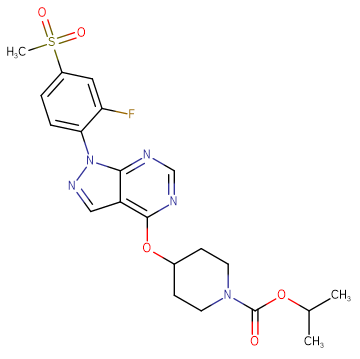
APD 668
CAS No. 832714-46-2
APD 668( JNJ-28630368 )
Catalog No. M16086 CAS No. 832714-46-2
APD668 is a potent GPR119 agonist with EC50 of 2.7 nM and 33 nM for hGPR119 and ratGPR119 respectively.
Purity : >98% (HPLC)
 COA
Datasheet
HNMR
HPLC
MSDS
Handing Instructions
COA
Datasheet
HNMR
HPLC
MSDS
Handing Instructions
| Size | Price / USD | Stock | Quantity |
| 2MG | 67 | In Stock |


|
| 5MG | 110 | In Stock |
|
| 10MG | 178 | In Stock |
|
| 25MG | 340 | In Stock |
|
| 50MG | 501 | In Stock |
|
| 100MG | 696 | In Stock |
|
| 200MG | Get Quote | In Stock |
|
| 500MG | Get Quote | In Stock |
|
| 1G | Get Quote | In Stock |
|
Biological Information
-
Product NameAPD 668
-
NoteResearch use only, not for human use.
-
Brief DescriptionAPD668 is a potent GPR119 agonist with EC50 of 2.7 nM and 33 nM for hGPR119 and ratGPR119 respectively.
-
DescriptionAPD668 is a potent GPR119 agonist with EC50 of 2.7 nM and 33 nM for hGPR119 and ratGPR119 respectively.(In Vitro):APD668 increases adenylate cyclase activation in HEK293 cells transfected with human GPR119 in a concentration-dependent manner with an EC50 of 23 nM.APD668 is highly bound to plasma proteins of male and female cynomolgus monkeys and humans (?99%), but is less extensively bound to male (93.0%) and female (96.6%) rats.(In Vivo):APD668 (10-30 mg/kg; p.o. once daily for 8 weeks) significantly reduces blood glucose and glycated hemoglobin (HbA1c) levels, with no desensitization of the acute drug response.APD668 (1-10 mg/kg; a single p.o.) markedly reduces blood glucose levels during oral glucose tolerance test in a dose-dependent manner in mice.APD668 (0.08 mg/kg/min; i.v.) shows no effect during euglycemic condition, but significantly stimulates insulin release when blood glucose levels are raised to approximately 300 mg/dl in a hyperglycemic clamp model in the Sprague-Dawley rat.APD668 (p.o.) exhibits rapid to moderate absorption (tmax≤2 h) in mice, rats, and monkeys, but slower in dogs (tmax=6 h), and moderate to good absolute oral bioavailability (44-79%) in mice, rats, and monkeys, but lower in dogs (22%).
-
In VitroAPD668 increases adenylate cyclase activation in HEK293 cells transfected with human GPR119 in a concentration-dependent manner with an EC50 of 23 nM.APD668 is highly bound to plasma proteins of male and female cynomolgus monkeys and humans (?99%), but is less extensively bound to male (93.0%) and female (96.6%) rats.
-
In VivoAPD668 (10-30 mg/kg; p.o. once daily for 8 weeks) significantly reduces blood glucose and glycated hemoglobin (HbA1c) levels, with no desensitization of the acute drug response.APD668 (1-10 mg/kg; a single p.o.) markedly reduces blood glucose levels during oral glucose tolerance test in a dose-dependent manner in mice.APD668 (0.08 mg/kg/min; i.v.) shows no effect during euglycemic condition, but significantly stimulates insulin release when blood glucose levels are raised to approximately 300 mg/dl in a hyperglycemic clamp model in the Sprague-Dawley rat.APD668 (p.o.) exhibits rapid to moderate absorption(tmax≤2 h) in mice, rats, and monkeys, but slower in dogs (tmax=6 h), and moderate to good absolute oral bioavailability (44-79%) in mice, rats, and monkeys, but lower in dogs (22%). Animal Model:Male Zucker Diabetic Fatty (ZDF) rats (6 weeks old, 200-250 g)Dosage:10, 30 mg/kg Administration:P.o. once daily for 8 weeksResult:Decreased the blood glucose and HbA1c levels at 30 mg/kg/day.
-
SynonymsJNJ-28630368
-
PathwayCell Cycle/DNA Damage
-
TargetGPR
-
RecptorGPR119
-
Research AreaMetabolic Disease
-
Indication——
Chemical Information
-
CAS Number832714-46-2
-
Formula Weight477.51
-
Molecular FormulaC21H24FN5O5S
-
Purity>98% (HPLC)
-
SolubilityDMSO: 10 mM
-
SMILESO=C(N1CCC(OC2=C3C(N(C4=CC=C(S(=O)(C)=O)C=C4F)N=C3)=NC=N2)CC1)OC(C)C
-
Chemical Nameisopropyl 4-((1-(2-fluoro-4-(methylsulfonyl)phenyl)-1H-pyrazolo[3,4-d]pyrimidin-4-yl)oxy)piperidine-1-carboxylate .
Shipping & Storage Information
-
Storage(-20℃)
-
ShippingWith Ice Pack
-
Stability≥ 2 years
Reference
1.Semple G, et al. Bioorg Med Chem Lett. 2011 May 15;21(10):3134-4
molnova catalog



related products
-
WAY-298630
(2-{[2-(2-fluorophenoxy)ethyl]sulfanyl}-1H-benzimidazol-1-yl)acetic acid is a prostaglandin-like CRTH2 antagonist with an IC50 < 10 μM, which can be used in studies of rhinitis, COPD, rheumatoid arthritis, eczema and conjunctivitis.
-
PF 429242
PF-429242 is a competitive inhibitor of sterol regulatory element-binding protein (SREBP) site 1 protease (IC50 = 0.175 μM).
-
Dihydromunduletone
Dihydromunduletone (DHM) is an adhesion G protein-coupled receptor (aGPCR) antagonist that acts as a chemical probe for the inhibition of GPR56 and GPR114/ADGRG5, which have similar tethered agonists.
